

July 2026 brought a major shift in US-China trade relations. The Section 122 global import surcharge expired on July 24, and a sweeping new Section 301 tariff took effect on the same day. Importers now face a fast-moving tariff environment. This article breaks down the three most important developments and provides actionable strategies for managing the changes.
Tariff rates and effective dates change frequently. Confirm final classifications and duties with official USTR and CBP guidance or a licensed customs broker.
Three major Trade Policy events converged in late July 2026, creating both challenges and opportunities for importers sourcing from China.
The 10% global import surtax imposed under Section 122 of the Trade Act of 1974, which had been in effect since February 24, 2026, expired on July 24, 2026, at midnight. Congress did not extend it, so the surcharge automatically terminated. Most imported goods have since returned to their base Most Favored Nation (MFN) tariff rates. However, other tariff measures, including Section 301 and Section 232, continue to apply.
The U.S. Trade Representative (USTR) issued a final determination under Section 301 of the Trade Act of 1974, finding that 60 economies had failed to implement and effectively enforce prohibitions on importing goods produced with forced labor. The remedy is a differentiated tariff structure.
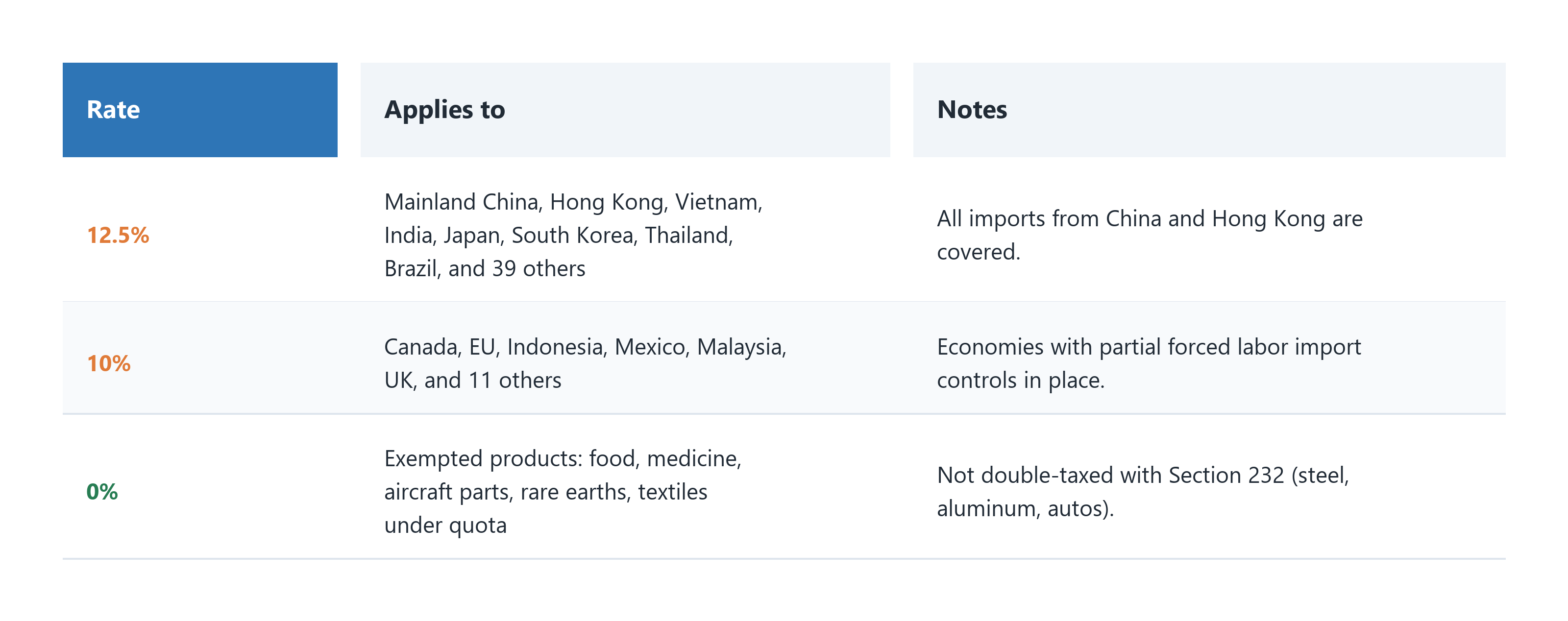
The new Section 301 tariff applies to goods entered for consumption or withdrawn from warehouse on or after 12:01 AM Eastern Time on July 24, 2026. Goods that were loaded on board a vessel at the port of loading and in final transit before July 24, and entered before July 28, 2026, are exempt.
On a more positive note, the U.S. and China have agreed in principle to a reciprocal tariff reduction framework covering approximately $30 billion worth of goods from each side. Key categories expected to benefit include:
Consumer electronics accessories
Household goods and home furnishings
Apparel and footwear
Light industrial products
Certain chemical and plastic products
Industrial machinery components
Non-sensitive medical supplies
Processed agricultural goods
The USTR public comment period has closed, and the final list is expected to be published soon. Importers should monitor which specific HS codes make the final cut.
Goods imported from China in August 2026 may now be subject to up to three layers of tariffs.
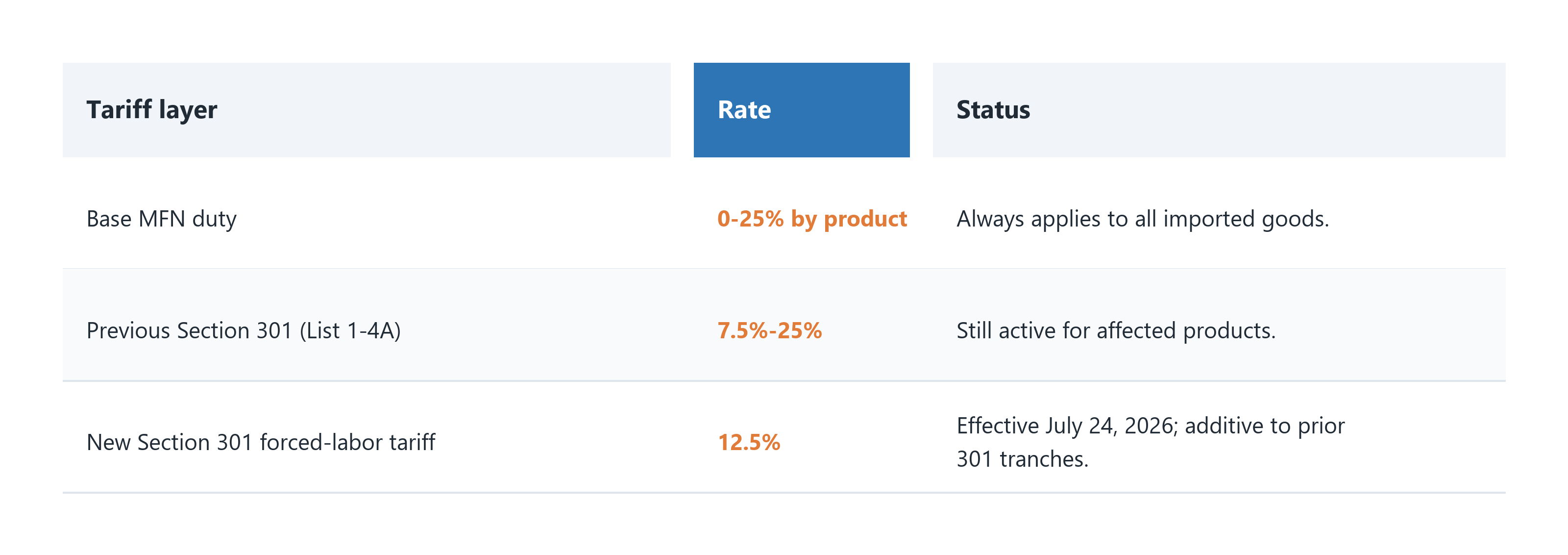
Importers should note that the new Section 301 tariff does not stack with Section 232 tariffs on steel, aluminum, and automobiles. For other products, the new tariff is additive to existing Section 301 tariffs from previous tranches.
Audit your product HS codes immediately. Identify which of your imported products are subject to which tariff layers. Check if any of your products are on the proposed $30B reduction list. A clear commercial invoice with the right HS code is the starting point for accurate duty calculation.
Evaluate alternative sourcing origins. Products sourced from China face the full 12.5% new tariff. Compare total landed costs from alternative origins in Southeast Asia, South Asia, or Latin America. If you are exploring China Sourcing alternatives, run the numbers with all duties, freight, and lead times included.
Review supply chain contracts. Determine which party bears tariff cost under your current incoterms and supplier agreements. Consider renegotiating cost-sharing terms.
Utilize bonded warehouses and Foreign Trade Zones. Goods can be stored in FTZs duty-free until they enter U.S. commerce, providing flexibility for timing market entry.
File for tariff exclusions where available. Monitor USTR announcements for product exclusion processes and submit applications promptly.
Work with a customs broker. Professional Customs Clearance support is essential for correctly classifying products and claiming all applicable exemptions and deductions.
Section 122 of the Trade Act of 1974 gives the U.S. President authority to impose temporary import surcharges. The 10% global surcharge that took effect in February 2026 expired on July 24, 2026.
No. The new Section 301 forced-labor tariff does not stack with Section 232 tariffs on steel, aluminum, and automobiles. For most other products, it is added on top of existing Section 301 tranches.
Yes, under the transition rule. Goods loaded on board a vessel at the port of loading and in final transit before July 24, 2026, and entered before July 28, 2026, are exempt from the new Section 301 tariff.
It is a U.S.-China agreement in principle to reduce tariffs on roughly $30 billion worth of goods from each side. The final list of HS codes has not been published yet.
Start by auditing HS codes and reviewing product classifications. Then compare alternative sourcing origins, renegotiate Incoterms, use bonded warehouses or FTZs, and apply for exclusions when they become available.
linkyourfactory provides customs clearance and trade compliance support for China-sourced goods. Our team monitors tariff developments daily and can help optimize your import strategy. If you need help with Shipping Rates, HS code reviews, or end-to-end Ocean Freight coordination, get in touch.
Related: Customs clearance | FCA vs FOB | Commercial invoice guide | Ocean freight
Copyright @ Link your factory
SitemapBack to top
This website uses cookies to ensure you get the best experience on our website.



 E-mail
Comment
(0)