

The global container shipping market entered 2026 carrying forward the structural supply-demand imbalances that defined late 2025. Despite expectations of a traditional pre-Chinese New Year peak season, spot freight rates have exhibited counter-seasonal weakness, with the Ningbo Containerized Freight Index (NCFI) falling to 852.8 points by late January — a 12.6% decline in a single week.
According to the China Ministry of Transport, the China Containerized Freight Index (CCFI) averaged 1,221.80 points in April 2026, up 11.4% month-on-month, while the Shanghai Containerized Freight Index (SCFI) averaged 1,883.78 points, up 11.9%. However, this apparent recovery masks significant route-level divergence and underlying structural pressures.
The global container fleet capacity exceeded 33 million TEU in 2025, and Alphaliner projects further growth to 34.7 million TEU in 2026 — a 3.8% year-on-year increase. By 2027, capacity is expected to reach 37.8 million TEU. Large and ultra-large vessels comprise nearly 50% of this growth, primarily deployed on Asia-Europe and Trans-Pacific mainline routes, intensifying the risk of overcapacity on core trade lanes.
The potential full resumption of Suez Canal transits presents an additional supply-side risk. French carrier CMA CGM announced plans to resume Red Sea passages in early 2026. If Suez Canal transits fully normalize, the Ningbo Shipping Exchange estimates an effective capacity release of approximately 10%, pushing the container overcapacity rate from the current 3.5-4% to 14-15%.
Suez Canal recovery could drive Asia-Europe freight rates back to 2023 levels ($1,100-1,600/FEU), potentially breaching the $1,500/FEU industry cost floor and significantly compressing carrier profit margins.
World Bank forecasts global GDP growth of just 2.4% in 2026, while the WTO projects global merchandise trade volume growth of only 0.5% — markedly below the 2.4% recorded in 2025. China's trade pattern has shifted toward an "East rising, West stabilizing, US declining" configuration. Trade with ASEAN, Africa, and the Middle East continues to grow at over 10%, providing a crucial buffer for port throughput.
China's Q1 2026 exports grew 14.7% year-on-year in USD terms, according to the General Administration of Customs. Major ports like Shanghai and Ningbo-Zhoushan handled over 55 million TEU and 43 million TEU respectively in 2025, with continued growth in 2026.
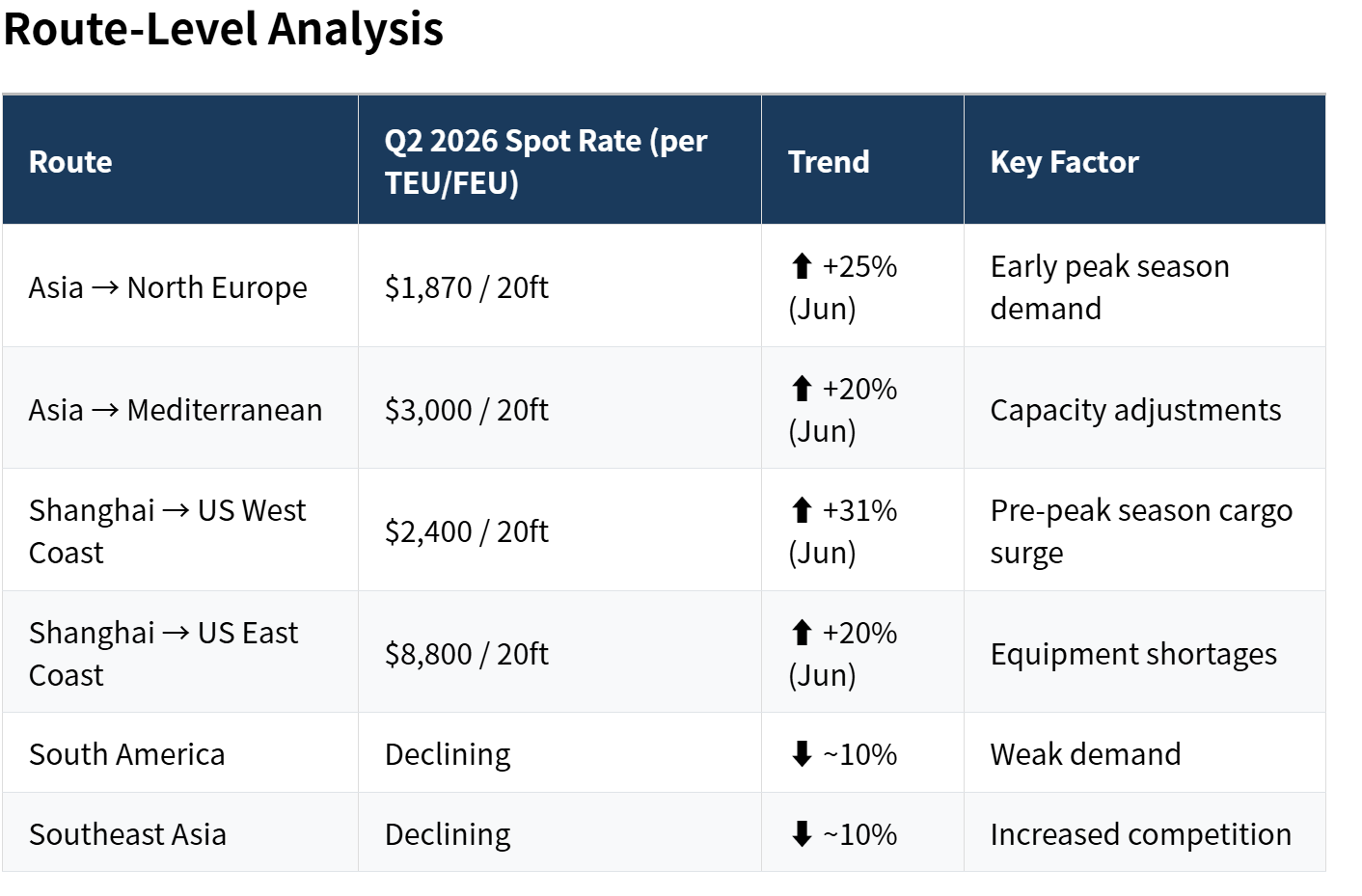
One of the most discussed phenomena in the 2026 market is the coexistence of overall capacity surplus with structural container shortages — particularly 40HC high-cube containers at key Chinese export hubs. This contradiction stems from the disruption of empty container repositioning caused by Red Sea diversions. Longer voyage times (adding 10-14 days per round trip) have significantly reduced empty container turnover efficiency, creating a "shortage in China, accumulation in Europe and North America" imbalance.
For shippers, this means paying premium fees for priority equipment pickup or sourcing containers from neighboring cities, adding both time and cost to the export process.
Given the volatile market conditions, exporters and importers should consider the following strategies:
Book early and confirm space: With carriers implementing widespread blank sailings and capacity management, early booking confirmation is essential.
Diversify routing options: Consider alternative origin ports and transshipment routes to mitigate congestion risk.
Negotiate long-term contracts: Multi-month or annual contracts with carriers can provide rate stability in a volatile spot market.
Monitor equipment availability: Stay in close contact with freight forwarders regarding container type and availability, particularly for 40HC boxes.
Build schedule buffers: Allow additional lead time in supply chain planning to accommodate schedule deviations.
Copyright @ Link your factory
SitemapBack to top
This website uses cookies to ensure you get the best experience on our website.



 E-mail
Comment
(0)