

Picking the right Incoterm decides who pays for freight, who carries the risk, and where your responsibility ends. FCA (Free Carrier) and FOB (Free On Board) are two of the most used terms in international trade, and they are easy to mix up. This guide explains the difference in plain English, so you can choose the right one for your next shipment.
FCA is an Incoterm issued by the International Chamber of Commerce (ICC). It works for every mode of transport: air, sea, road, rail, and multimodal. Under FCA, the seller's job ends when the goods are handed over to the carrier, or to another party the buyer names, at an agreed place. That place can be the seller's premises, a warehouse, a cargo terminal, or a port.
Deliver the goods to the agreed place.
Complete export Customs Clearance and provide all export documents.
Cover all costs and risks up to the delivery point.
Arrange and pay for the main carriage (international freight).
Take over risk from the moment the goods reach the agreed place.
Arrange cargo insurance for the transport leg.
Handle import clearance and pay duties or taxes.
FOB is designed for sea and inland waterway transport only. The seller's job ends when the goods are loaded on board the vessel the buyer nominated, at the port of shipment. From that point, risk and responsibility move to the buyer.
Deliver the goods to the port of shipment and load them onto the vessel.
Complete export clearance and provide the shipping documents, such as a commercial invoice, packing list, and bill of lading.
Bear all costs and risks until the goods are on board.
Arrange and pay for Ocean Freight to the destination port.
Take over risk once the goods are loaded on board.
Arrange marine cargo insurance if needed.
Handle import clearance and all costs at the destination.
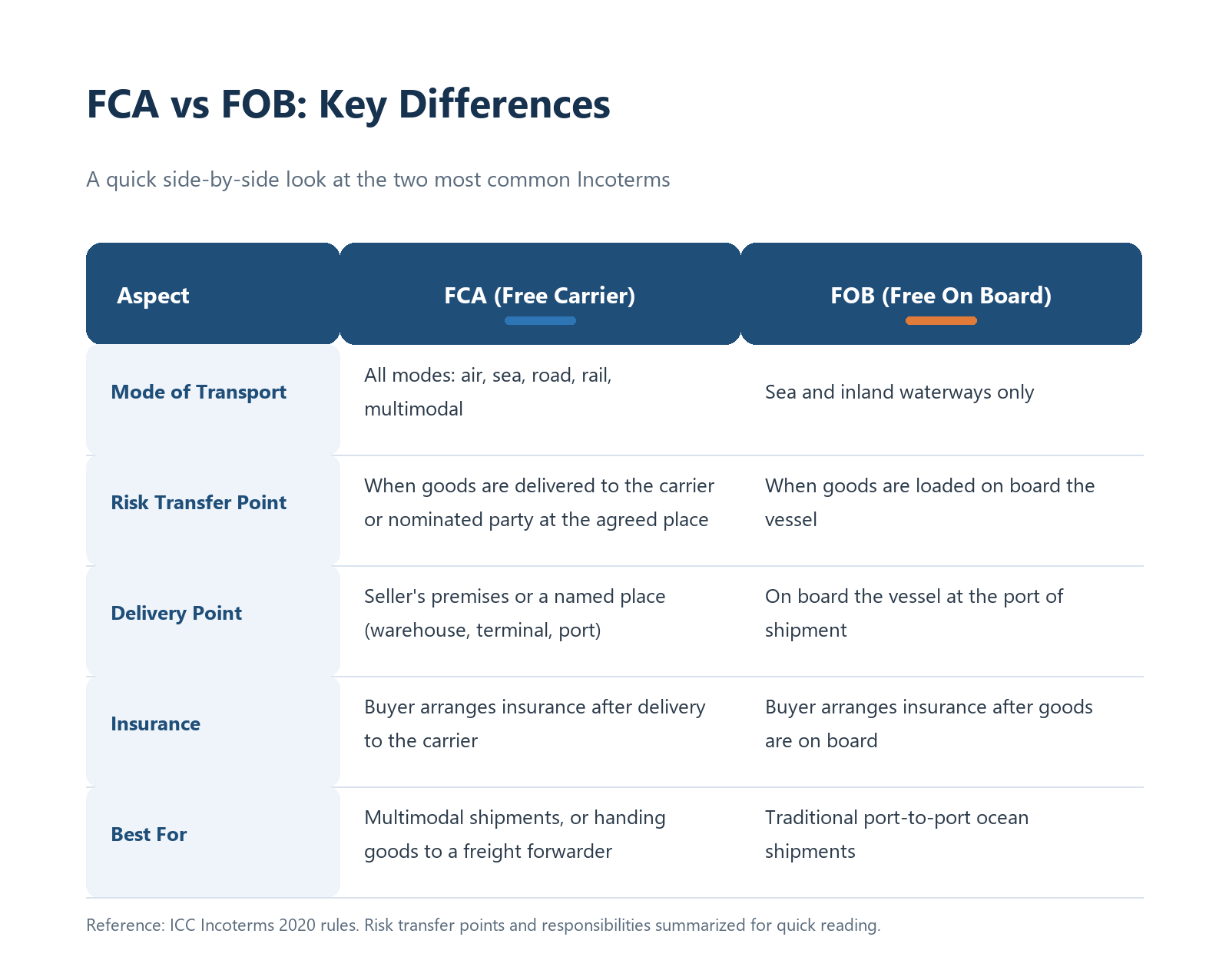
The table below summarizes the key differences at a glance.

Despite the differences, both terms share a few basics:
Export clearance: the seller clears the goods for export under both terms.
Documents: the seller provides the commercial invoice, packing list, and certificate of origin.
Import side: the buyer handles import clearance and pays duties under both terms.
No door delivery: neither term requires the seller to deliver the goods to the buyer's final destination.
Mode of transport. If your shipment uses more than one mode, such as truck to the airport and then air freight, FCA is the right call. For port to port ocean shipments, FOB is still the standard.
Control over the freight leg. Buyers who want to control the ocean leg prefer FOB, because they nominate the vessel and negotiate Shipping Rates. FCA lets the buyer bring in their own carrier from the seller's location.
Risk transfer point. FCA passes risk to the buyer earlier, at the handover to the carrier. FOB keeps the seller responsible until the goods are physically on board, which some sellers prefer.
Trade practice. FOB is traditional in bulk commodities and containerized ocean freight. FCA is used more in multimodal and air freight.
The 2020 edition added an option that matters for FCA users. When both parties agree, the seller can ask the carrier to issue an on board bill of lading after loading, even though the risk already passed at the earlier delivery point. This helps when a letter of credit requires an on board bill of lading, a common demand in documentary trade.
For exporters: under FCA, your job ends at the delivery point, so you avoid port handling and loading risks. Under FOB, you must load the goods on board, so plan extra insurance coverage during the loading phase.
For importers: FCA gives you more say in carrier choice and inland logistics. FOB gives you control at the loading port and clearer oversight of the ocean leg.
Yes. FOB applies to sea and inland waterway transport only. For air, road, or rail shipments, use FCA or another Incoterm.
Yes. FCA covers all transport modes, including sea. Many containerized ocean shipments work well under FCA because the risk transfers when the container is handed to the carrier, not when it is loaded on board.
FCA transfers risk earlier. Under FCA, risk passes at the handover to the carrier. Under FOB, risk passes only after the goods are loaded on board the vessel.
The seller arranges export customs clearance under both terms. The buyer handles import clearance and pays duties in both cases.
FCA and FOB are both solid Incoterms, each built for a different situation. FCA covers all transport modes and transfers risk earlier, which makes it a good fit for multimodal shipments and Container Freight. FOB stays the preferred choice for traditional port to port ocean shipments, where the buyer wants to take over only after the goods are on board.
Not sure which term fits your cargo? Talk to a freight forwarder before you sign the contract. A quick check on the route, the mode of transport, and the payment terms will point you to the right answer.
Copyright @ Link your factory
SitemapBack to top
This website uses cookies to ensure you get the best experience on our website.



 E-mail
Comment
(0)