

If you are importing goods from China to the United States, few documents matter more than the commercial invoice. It serves as both a bill of sale between buyer and seller and the primary document U.S. Customs and Border Protection (CBP) uses to assess duties, verify compliance, and clear your shipment.
At linkyourfactory, we help importers get this right every time. Here is everything you need to know about commercial invoices: what they must include, why they matter, and how to avoid costly mistakes.
A commercial invoice is a legal document issued by the exporter (seller) to the importer (buyer) for international shipments. Unlike a standard receipt, it contains detailed information about the goods, their value, and the terms of the transaction.
For shipments from China to the U.S., CBP relies on this document to:
Determine the correct amount of duties and taxes.
Verify that the goods comply with U.S. import regulations.
Detect potential fraud or misdeclaration.
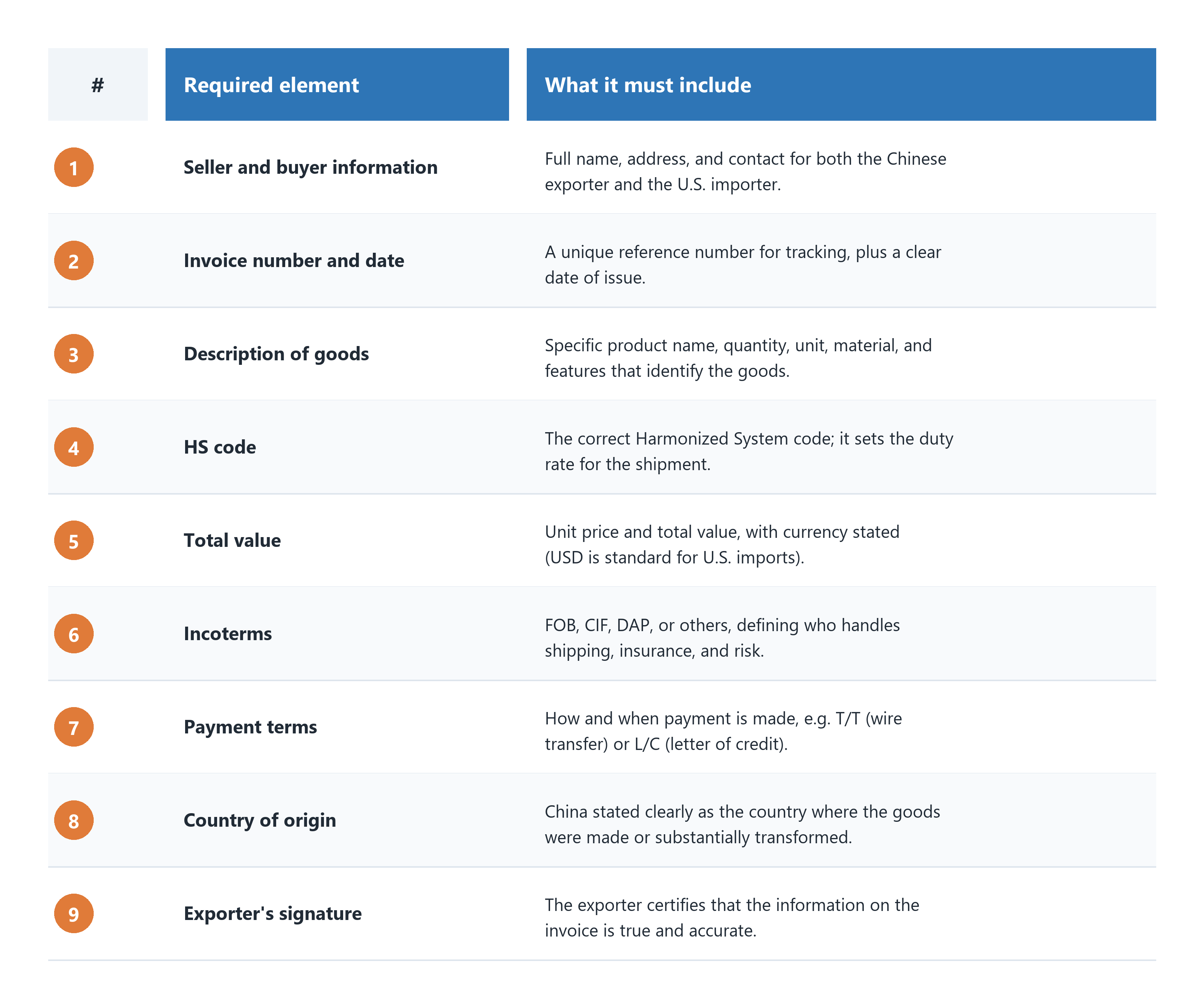
A complete and compliant commercial invoice must include the following:
Include the full name, address, and contact details of both the Chinese exporter and the U.S. importer. Make sure names match the business records and shipping documents.
Each invoice needs a unique reference number for tracking. The date of issuance must also be clearly stated.
Generic terms like "electronics" or "spare parts" are not enough. CBP expects specific, clear descriptions that include product name and type, quantity and unit of measurement, material composition, and any distinguishing features that help identify the goods.
The HS code is a standardized numerical classification for traded goods. It determines the duty rate your shipment will be subject to. Assigning the wrong code is one of the most common and most costly mistakes importers make.
The invoice must show both the unit price and the total value of the shipment, clearly indicating the currency. USD is standard for U.S. imports.
Incoterms define who is responsible for shipping, insurance, Customs Clearance, and risk at each stage of transit. Common terms between China and the U.S. include:
FOB (Free on Board): The seller delivers goods to the port; the buyer takes responsibility from there.
CIF (Cost, Insurance, and Freight): The seller covers cost, insurance, and freight to the destination port.
DAP (Delivered at Place): The seller bears all risks and costs until the goods arrive at the buyer's specified location.
For more detail, see our guide on FCA vs FOB Incoterms.
Specify how and when payment will be made, for example T/T (wire transfer), L/C (letter of credit), or other agreed terms.
"China" must be clearly stated as the country where the goods were manufactured or substantially transformed.
The exporter's signature certifies that the information on the invoice is true and accurate.
Even a small mistake on a commercial invoice can trigger delays, additional inspections, or financial penalties. Accuracy is non-negotiable because of three main risks:
Customs clearance. CBP uses the invoice as the primary reference for clearing your goods. Errors can hold your shipment at the border.
Duty calculation. Duties are calculated based on HS codes and declared values. Incorrect information can lead to overpayment or underpayment, which may result in fines.
Legal compliance. The commercial invoice serves as a legally binding record of the transaction. Discrepancies between the invoice and the actual goods can raise red flags.
Vague product descriptions. Phrases like "various items" or "general merchandise" are not acceptable. Be specific.
Wrong HS codes. Using a code that does not match the goods can result in incorrect duty rates and penalties.
Incorrect valuation. Undervaluing goods to reduce duties is risky and illegal. CBP actively audits declared values.
Missing Incoterms. Failing to specify Incoterms leaves shipping responsibilities unclear, which can cause disputes and unexpected costs.
Review every detail before the invoice is issued. Check names, addresses, HS codes, values, and signatures.
Work with a freight forwarder or customs broker. They can help ensure your documentation meets both Chinese export requirements and U.S. import regulations. If you are comparing Ocean Freight or air options, ask them to align the Incoterms with the shipping quote.
Use standard Incoterms clearly and correctly. This avoids confusion over who handles shipping, insurance, and risk at each stage.
Partner with a reliable sourcing platform. linkyourfactory provides expert guidance on documentation, compliance, and logistics from factory to destination.
CBP may hold your shipment for inspection, reassess duties, issue fines, or even seize the goods in serious cases. Fixing errors after arrival is slow and expensive.
A pro forma invoice is used before the sale is finalized. CBP requires a commercial invoice for customs clearance, which reflects the actual transaction.
Yes. Each exporter should issue its own commercial invoice. If you consolidate shipments from multiple suppliers, keep each invoice separate and attach them to the customs entry.
Yes. The description, quantity, value, and total should match across the commercial invoice, packing list, and any other shipping documents.
The exporter or an authorized representative of the exporter signs the commercial invoice to certify that the information is true and accurate.
linkyourfactory provides end-to-end support for sourcing and importing from China, including commercial invoices, packing lists, export documents, and shipping arrangements. Get in touch and keep your shipments moving.
Related: Customs clearance | FCA vs FOB | Ocean freight | Shipping Rates
Copyright @ Link your factory
SitemapBack to top
This website uses cookies to ensure you get the best experience on our website.



 E-mail
Comment
(0)