

Most container delays are not caused by the ocean. They are caused by paperwork, money, and equipment. The seven usual culprits are missing or mismatched documents, a customs hold or physical exam, unpaid freight or a missing telex release, a rolled booking at the origin port, terminal congestion, no chassis or no trucker available for pickup, and a compliance failure such as a late ISF or a missing product certificate. Six of those seven are preventable before the vessel sails.
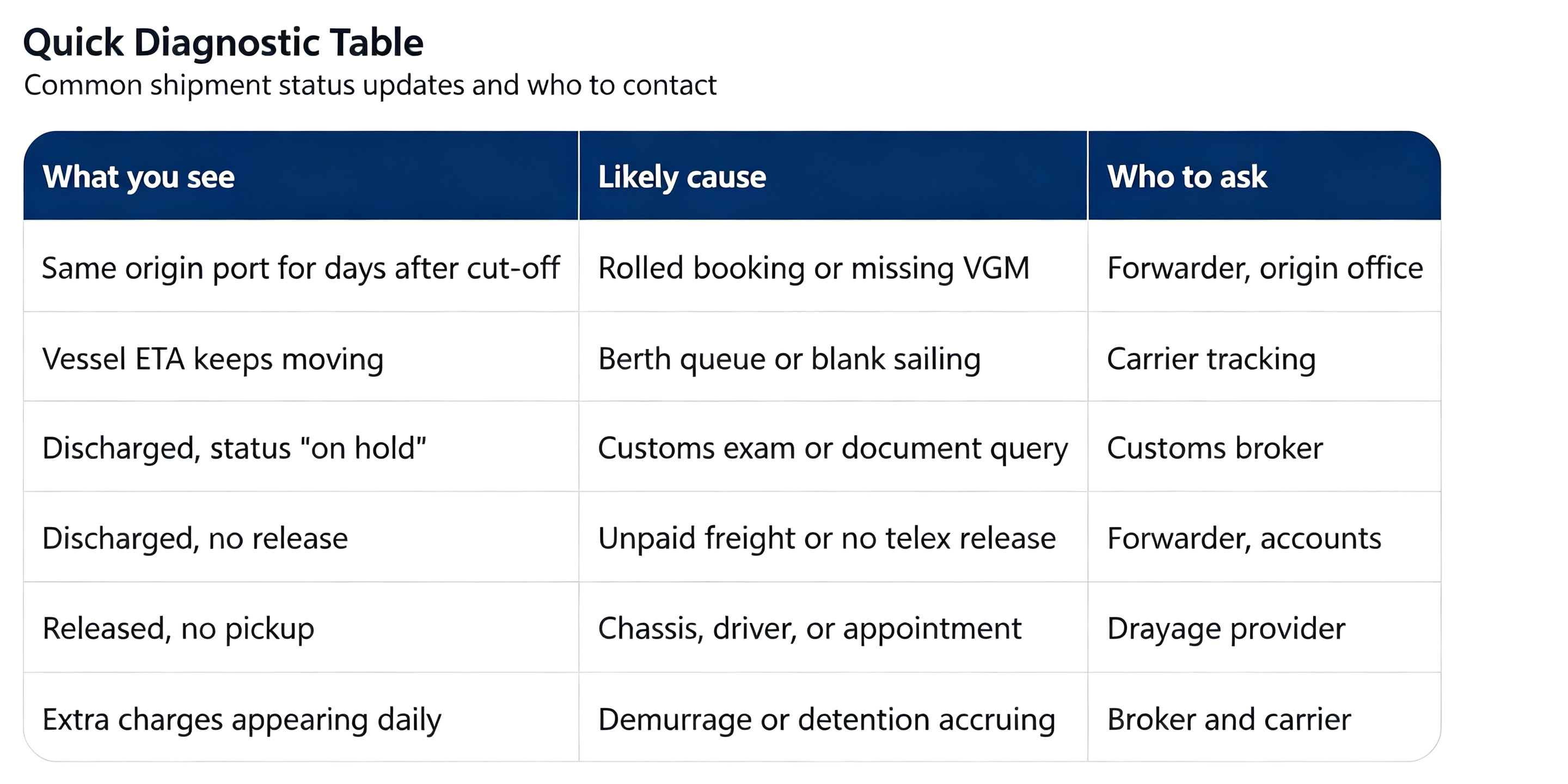
Before chasing anyone, find out where the box actually sits. Each position has a different owner:
At origin, not loaded: booking or documentation problem
On the water, ETA slipping: carrier issue or blank sailing
Discharged, not released: customs, unpaid charges, missing release
Released, not collected: trucking, chassis, or appointment
Pull the bill of lading number, check carrier tracking, then ask your forwarder for terminal status and customs entry status separately. Those are two different systems, and a shipment can be clear in one while blocked in the other.
The most common cause by far. Customs compares the bill of lading, commercial invoice, packing list, and entry data. Any mismatch in piece count, weight, description, consignee name, or value triggers a query.
Typical triggers:
Packing list says 1,200 cartons, invoice says 1,180
Goods described as "gift items" rather than the actual commodity
Consignee legal name on the BL differs from the registered name
HS code on the entry doesn't match the goods invoiced
The fix: review the draft BL and commercial invoice before the vessel departs, not after arrival. Match the goods description word for word across all three documents. If the supplier prepares the invoice, give them a template and refuse variations.
Customs can select a container for document review, X-ray, or a full devanning exam. Some selections are risk-based, some random. A document review might take a day, an X-ray two to four days, and a full exam one to two weeks plus several hundred dollars in handling, with demurrage running the whole time.
The fix: you cannot eliminate exams, but you can lower your risk profile. Declare accurate values, keep HS codes consistent between shipments, avoid vague descriptions, and answer customs requests the same day. File ISF, AMS, or ENS on time; late security filings raise your risk score and carry penalties up to $5,000 per violation in the US.
A carrier will not release cargo without payment and a valid release instruction. If you paid the supplier but the supplier has not paid their forwarder, the box sits. If an original bill of lading is still in a courier bag on someone's desk, the box sits.
The fix: agree telex release or a seaway bill in advance with trusted suppliers, and confirm in writing that freight is prepaid where the term says it should be. This type of port delay is purely administrative and the cheapest to prevent: one email a week before ETA confirming freight paid, release issued, and who settles arrival notice charges.
Your container was booked, gated in, then not loaded. In peak weeks carriers overbook and roll the lowest-paying cargo first. You usually find out days later, when tracking still shows the origin port and a new vessel name.
The fix: book 3 to 4 weeks ahead on peak lanes and ask for confirmed allocation, not a space request. Avoid the last vessel before Chinese New Year and the fortnight after Golden Week. Remember that the cheapest booking gets rolled first, which is why chasing the lowest Shipping Rates often costs more than it saves. Saving $150 per box is a poor trade against a ten-day roll.
Vessels queue when terminals are short-staffed, weather closes the port, or too many ships arrive in one window. Congestion also shows up as long gate queues, so even a released container waits days for a truck slot.
The fix: check port waiting times before booking and keep a secondary discharge port qualified. If Long Beach is running four days of berth delay, Oakland may be faster door-to-door despite longer rail. Build a 7 to 10 day buffer into Q4 planning instead of quoting customers the ETA on the booking confirmation.
The container is cleared and released, and still nothing moves. Chassis pools run dry, drayage capacity tightens, and terminal appointments fill days ahead.
The fix: nominate your trucker a week before ETA and send the BL and release details early so they can grab the first slot. Keep receiving hours flexible; a driver who can only deliver at 6 p.m. beats one who cannot deliver at all. Watch free time, since demurrage typically starts after 4 to 7 days and runs roughly 100 to 300 per container per day, escalating in tiers.
Other agencies can hold cargo even when customs is satisfied. Food and cosmetics face health review, electronics may need certification marks, wooden packaging needs ISPM 15 stamps, and battery shipments need correct dangerous goods declarations.
The fix: confirm certification before production, not before shipping. Photograph the ISPM 15 stamp during loading, get the DG declaration and MSDS for anything with a lithium battery, and keep test reports where you can produce them the same day.
Confirm booking with allocation, not just a space request
Review draft BL, invoice, and packing list 48 hours before cut-off
Verify VGM submission and container seal number
File security declarations on time (ISF 24 hours before loading)
Pre-arrange telex release or seaway bill
Nominate trucker and confirm the appointment before ETA
Diary your free time expiry date
Keep certificates and origin documents in one shared folder
None of this is complicated. It is a sequence that has to happen on time, every time. Importers running a standing checklist on every Ocean Freight booking see far fewer holds than those improvising per shipment.
Usually a document mismatch, a customs hold, unpaid freight or missing release, a rolled booking at origin, terminal congestion, or no chassis and driver. Establish whether the box is uncleared, unreleased, or simply uncollected, since each has a different owner.
A document query often clears in one to three days, an X-ray adds two to four, and a full physical exam can take one to two weeks. Other-agency holds on food, cosmetics, or certification can run longer.
Whoever holds the container past free time is billed, normally the consignee. Carriers sometimes waive charges caused by their own vessel delay or a terminal closure, but request it in writing with evidence at the time. Retroactive waivers are rare.
Demurrage accrues while the container sits inside the terminal past free time. Detention accrues after you pull it out and keep it beyond the allowed days before returning the empty.
Answer every information request the same day and send complete documents in one package rather than piecemeal. Beyond that the timeline belongs to the agency, so use the wait to lock in trucking.
Copyright @ Link your factory
SitemapBack to top
This website uses cookies to ensure you get the best experience on our website.



 E-mail
Comment
(0)