

Free time is the number of days the container can sit before either fee starts. Typical ranges, approximate as of mid-2026:
Terminal demurrage free time: about 4–7 days after discharge.
Carrier detention free time: about 7–14 days from pick-up.
These are not fixed. They vary by carrier, by port, and by the contract your forwarder negotiated. The single most useful thing you can do on any shipment is write down the free-time window and the per-day rate before the vessel sails, because after the fact the rate on the invoice is what it is.
Responsibility tracks the Incoterm.
Under ddp, the seller owns the whole chain and pays both fees if they mishandle the timing.
Under CIF or FOB, the buyer takes over at the port of loading (FOB) or arrival (CIF), and from that point the buyer controls pick-up and return, so the buyer usually pays demurrage and detention.
Under EXW, the buyer controls everything from the factory, so any delay anywhere is the buyer's cost.
This is why a slow customs broker or a missing document lands on your invoice, not the supplier's. You control the clock once the goods reach your side.
Daily rates escalate the longer the box sits. Approximate figures for a standard 40-foot container, mid-2026:
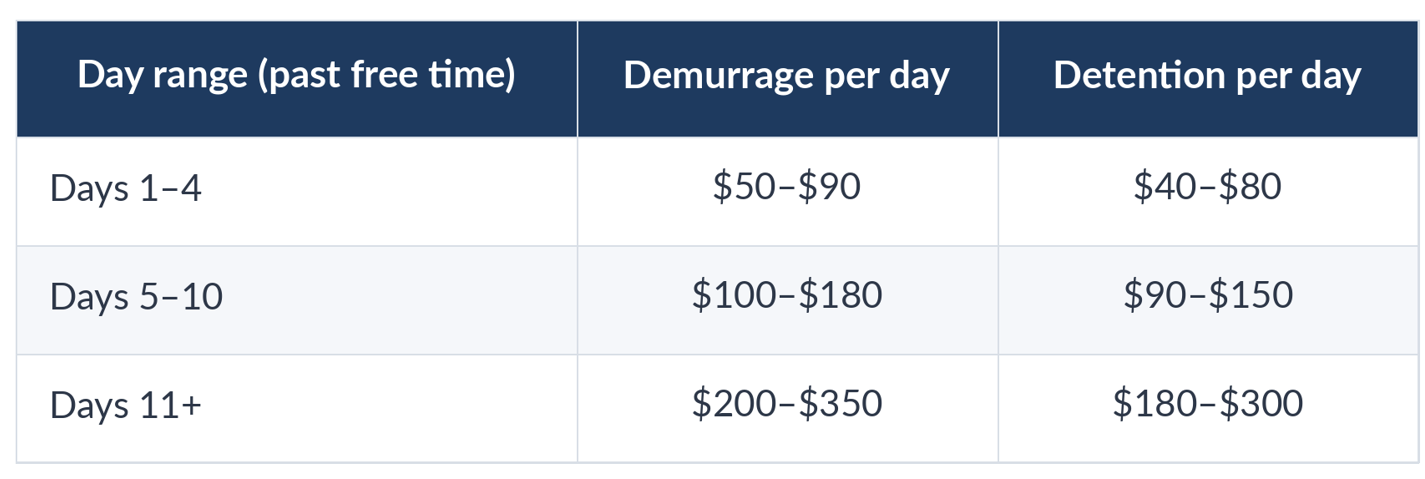
A container left two weeks past free time can therefore run $2,000–$4,000 in combined charges, sometimes more at peak. That wipes out the savings from a "cheap" freight quote fast. For more on protecting your rate, see our cost control guide and the Ocean Freight overview.
The fixes are boring and effective:
Pre-clear customs. Have your broker file entry as early as the law allows so the container is releasable the moment it lands.
Book drayage early. A truck appointment at the port should be confirmed before arrival, not arranged after.
Track the free-time clock. Set a calendar alert for the last free day. Treat it like a deadline, because it is one.
Speed up unloading. Tell your warehouse the empty must go back within X days; don't let a container sit in the yard for a week.
Negotiate free time up front. Some forwarders can buy an extra 2–3 days of free time for a small fee, cheaper than owing demurrage later.
Use the right Incoterm. If your team can't control the destination side, let the seller carry risk under DDP for the first shipment.
If you get a demurrage or detention invoice you think is wrong:
Pull the discharge date, pick-up date, and empty-return date from the carrier's records.
Check whether the delay was the carrier's (late vessel, no empty slot offered, documentation error on their side).
Dispute within the carrier's window, often 30–60 days, with the timeline attached.
If the delay came from a force majeure event the carrier declared, fees are sometimes waived.
Many of these charges survive only because the importer pays without questioning. A clean timeline wins a fair number of disputes. For a deeper dive into the fee mechanics, follow the demurrage tag.
What is the difference between demurrage and detention?
Demurrage is the port's charge for a full container sitting on the terminal past free time. Detention is the carrier's charge for a container kept out of their pool past free time. Different payer, different trigger.
Who pays demurrage, the buyer or seller?
It depends on the Incoterm. Under FOB/CIF the buyer usually pays once the goods reach their side; under DDP the seller does. Check your contract, not your assumption.
Can demurrage and detention be waived?
Sometimes. If the carrier caused the delay, or a declared force majeure applies, fees may be waived. You must dispute with a clear timeline inside their response window.
How much free time do I get?
Typically 4–7 days demurrage free time at the terminal and 7–14 days detention free time from pick-up, but it varies by carrier and port. Confirm it before sailing.
What is the fastest way to avoid these fees?
Pre-clear customs and book your truck before the vessel arrives. Most charges come from the box sitting while paperwork or a drayage slot catches up.
Copyright @ Link your factory
SitemapBack to top
This website uses cookies to ensure you get the best experience on our website.



 E-mail
Comment
(0)