

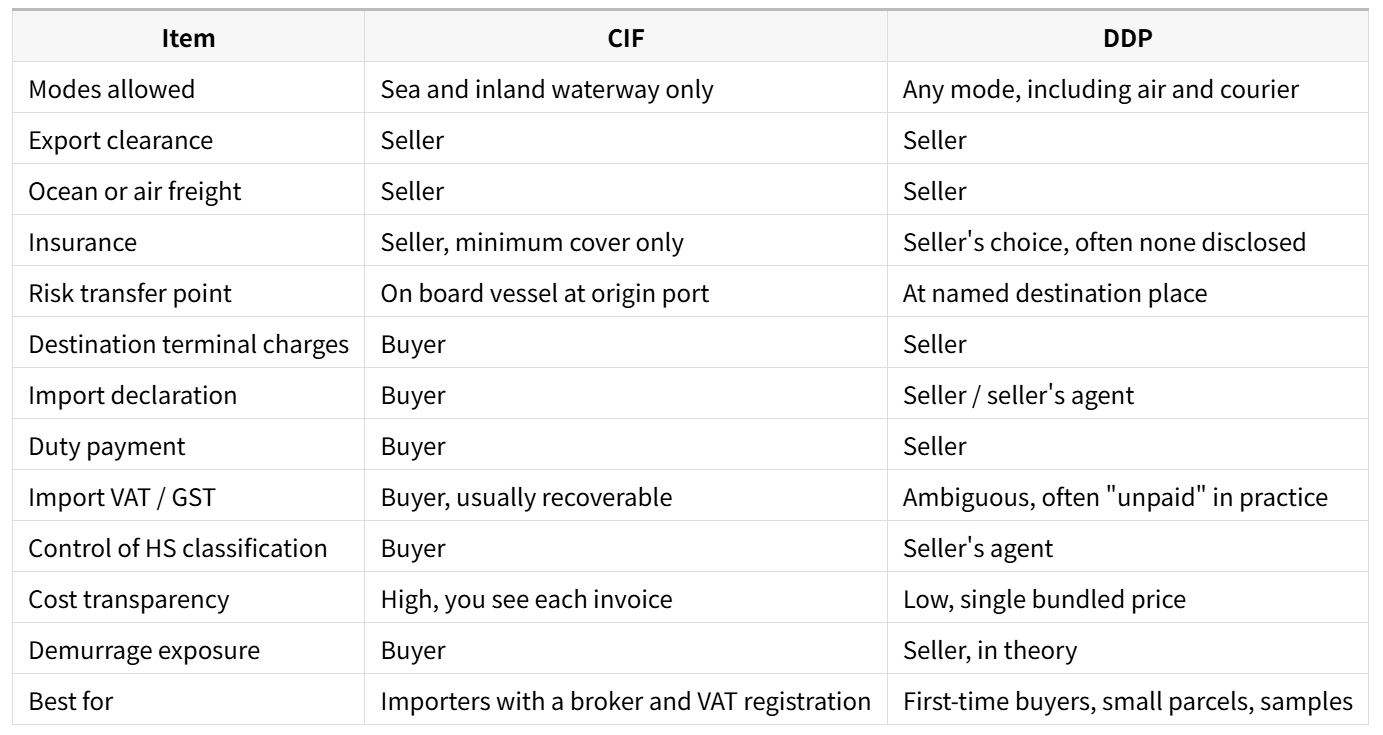
Neither term protects you automatically, but they fail in different directions. Under CIF the seller pays Ocean Freight and buys minimum insurance, then hands you risk the moment the goods are loaded on the vessel in China, leaving you responsible for import clearance, duty, and VAT. Under ddp the seller carries the goods all the way to your door and pays duty, which removes work but also removes your visibility into how the shipment was declared. If you have a customs broker and want control over classification, declared value, and destination charges, CIF gives you more protection. If you have no import capability at all, DDP is more practical, provided you verify what the seller actually files.
That last condition is where most DDP problems start.
CIF stands for Cost, Insurance and Freight. It applies to sea and inland waterway shipments only, and it works like this:
Seller arranges export packing, inland transport in China, export clearance, and ocean freight to your named destination port
Seller buys cargo insurance for at least 110% of the contract value
Risk transfers to you when the goods are loaded on board the vessel at the port of origin
You handle unloading charges, import declaration, duty, VAT, broker fees, and delivery to your warehouse
The risk transfer point catches people out. The seller pays for the voyage, but you own the risk during it. If the container goes over the side in the South China Sea, that is your claim to file, on a policy the seller purchased.
Also read the insurance terms. Minimum cover under CIF means Institute Cargo Clauses (C) or equivalent, which is a named-perils policy. It does not cover ordinary handling damage, water ingress from condensation, or theft in most cases. For manufactured goods you usually want Clauses (A), all-risk cover. Either specify it in the contract or buy your own policy and switch to CFR or FOB.
Delivered Duty Paid puts nearly everything on the seller: export clearance, freight by any mode, import clearance, duty, taxes, and delivery to the agreed place in your country. Risk transfers only when the goods are placed at your disposal at destination.
On paper that is the most seller-heavy of the incoterms. In practice, a Chinese supplier quoting DDP is usually reselling a service bought from a freight agent, and the price they gave you was built on assumptions they never shared. Two things commonly go wrong.
First, VAT. In the strict definition, DDP includes all import taxes, but a foreign seller usually cannot recover import VAT in your country, so many quotes are really "DDP, VAT unpaid," which is not a real Incoterm. You end up receiving a VAT bill you did not budget for. If the seller does pay it, they cannot reclaim it, so it is buried in your unit price as a permanent cost instead of a recoverable one.
Second, declared value. The seller's agent controls the declaration. Undervaluation to reduce duty is common on low-cost DDP lanes, and when customs audits the entry, the consignee is the party with a business presence, a bank account, and something to lose.
DDP is not a trap by default. It works well in specific situations:
Samples and small trial orders. Paying a broker $120 to clear a $600 box makes no sense.
Air and express shipments where the seller's forwarder already runs a consolidated clearance channel.
Buyers with no import infrastructure, such as a new e-commerce brand shipping straight to a third-party warehouse.
Lanes where the seller has real volume. A supplier moving forty containers a month to Rotterdam may hold better rates than you can get and pass some through.
Undervalued declarations that expose you in a post-clearance audit
No cargo insurance, or a policy you never see and cannot claim on
No import document in your name, which blocks VAT recovery and, in some countries, creates a permanent records gap
Wrong HS code chosen for the agent's convenience rather than your product, which can misclassify goods subject to anti-dumping duty or licensing
Delivery quoted to "your city" rather than a specific address with unloading responsibility defined
Abandoned shipments when duty turns out higher than the seller assumed and they refuse to top up
The pattern is consistent: DDP shifts the tasks to the seller, but it does not shift your legal position as the owner and beneficiary of the goods. Customs authorities look at who received and sold the merchandise.
Who is the importer of record on the declaration?
Is import VAT or GST included, and will I receive the entry document in my name?
What HS code will be used, and what declared value?
Is cargo insurance included, at what level of cover, and who is the named beneficiary?
Is the delivery address a specific door, and does the price include unloading and any waiting time?
What happens if the shipment is held for inspection, and who pays storage?
Get the answers in writing on the proforma invoice. A supplier who cannot answer these is not selling you DDP, they are selling you a guess.
For repeat orders above roughly one pallet, most importers are better off on FOB or CIF with their own broker and their own all-risk insurance. You see every cost, you control classification, you keep VAT recoverable, and you build a relationship with a forwarder who works for you rather than for the factory. Use DDP for samples, urgent air shipments, and situations where you truly cannot clear the goods yourself.
CIF is safer for buyers who can clear customs, because you control the declaration, the classification, and the paperwork trail needed for VAT recovery. DDP is safer only in the narrow sense that the seller absorbs operational hassle; it increases your compliance exposure because someone else declares your goods.
The buyer. CIF ends at the destination port. Duty, VAT, terminal handling, broker fees, and inland delivery are all yours.
Often not. Many China DDP quotes exclude import VAT, exclude unloading, and exclude storage if the shipment is inspected. Confirm the exclusions in writing before you agree the price.
Only at minimum level. CIF requires cover of 110% of contract value under restricted named-perils clauses. For manufactured goods, specify all-risk cover or buy your own policy.
No. CIF, CFR, FOB, and FAS apply to sea and inland waterway carriage. For air, use CPT, CIP, DAP, or DDP. CIF on an air waybill creates ambiguity that surfaces exactly when something goes wrong.
Copyright @ Link your factory
SitemapBack to top
This website uses cookies to ensure you get the best experience on our website.



 E-mail
Comment
(0)