

Policy details change often. Confirm final classifications, license requirements, and return procedures with official GAC, MOFCOM, and SAFE guidance or a licensed customs broker.
Chinese trade authorities released several policy updates in 2026 that affect cross-border operations. They range from a major Cross-Border E-Commerce return reform to updated export license rules. For exporters, understanding these changes helps keep Customs Clearance smooth and supply chain costs under control.
Effective April 1, 2026, China's General Administration of Customs (GAC) expanded the cross-customs-district return model for cross-border e-commerce retail export goods under Customs Code 9610 to a national scale. The model was previously piloted at 20 customs offices including Beijing, Shanghai, Guangzhou, Shenzhen, and Chengdu. It now applies across all Chinese customs districts.
Returned cross-border e-commerce retail export goods no longer need to re-enter through the original customs office. Companies may choose any customs port in China for return entry procedures. This gives e-commerce exporters much more flexibility in managing returns.
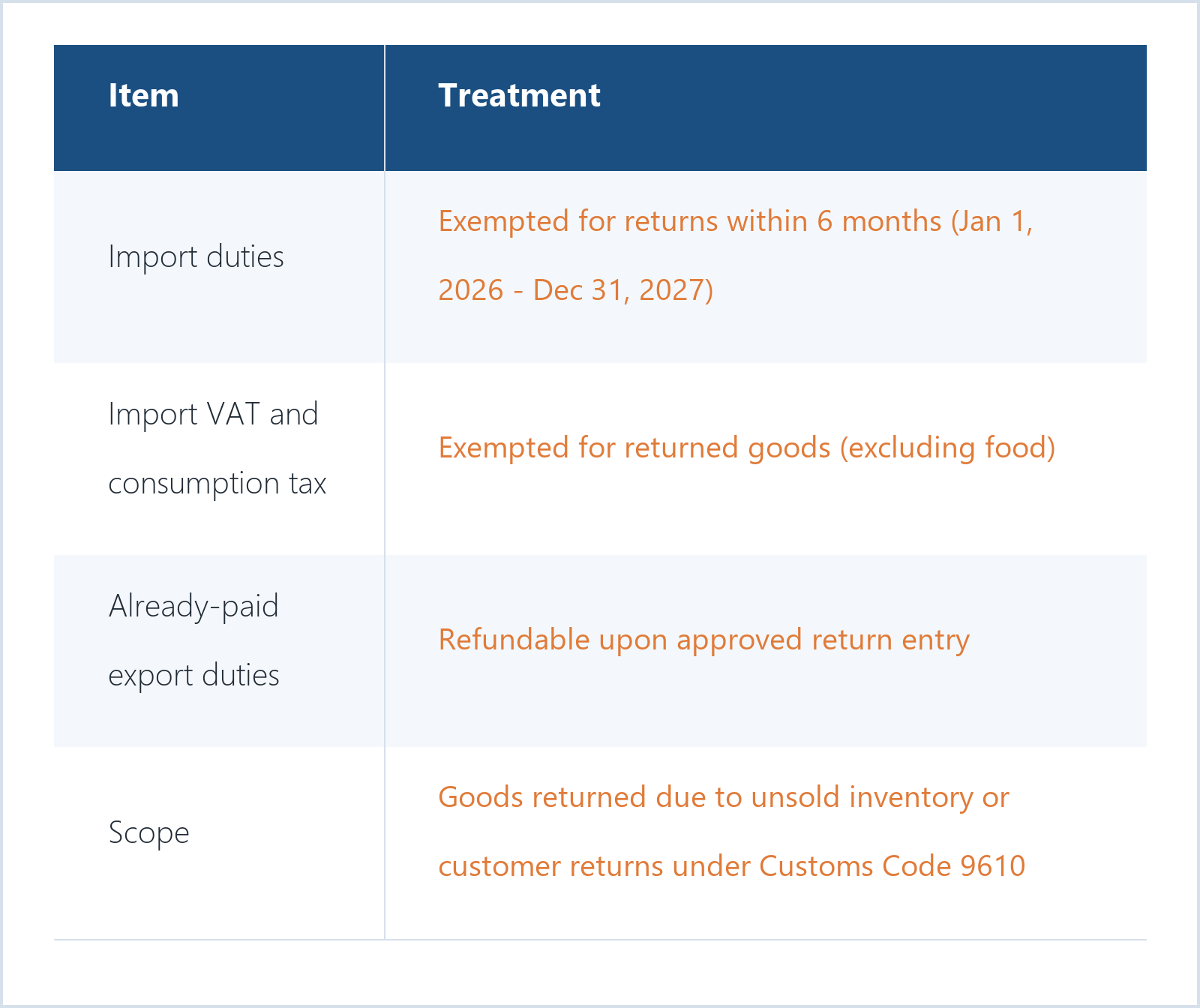
This reform targets one of the industry's biggest pain points: reverse logistics. Combined with the February 2026 tax incentive, which exempts import duties and VAT on returned goods (excluding food) that re-enter China within six months, the policy lowers return costs, shortens processing times, and improves working capital turnover.
For cross-border e-commerce export goods returned within six months between January 1, 2026 and December 31, 2027:
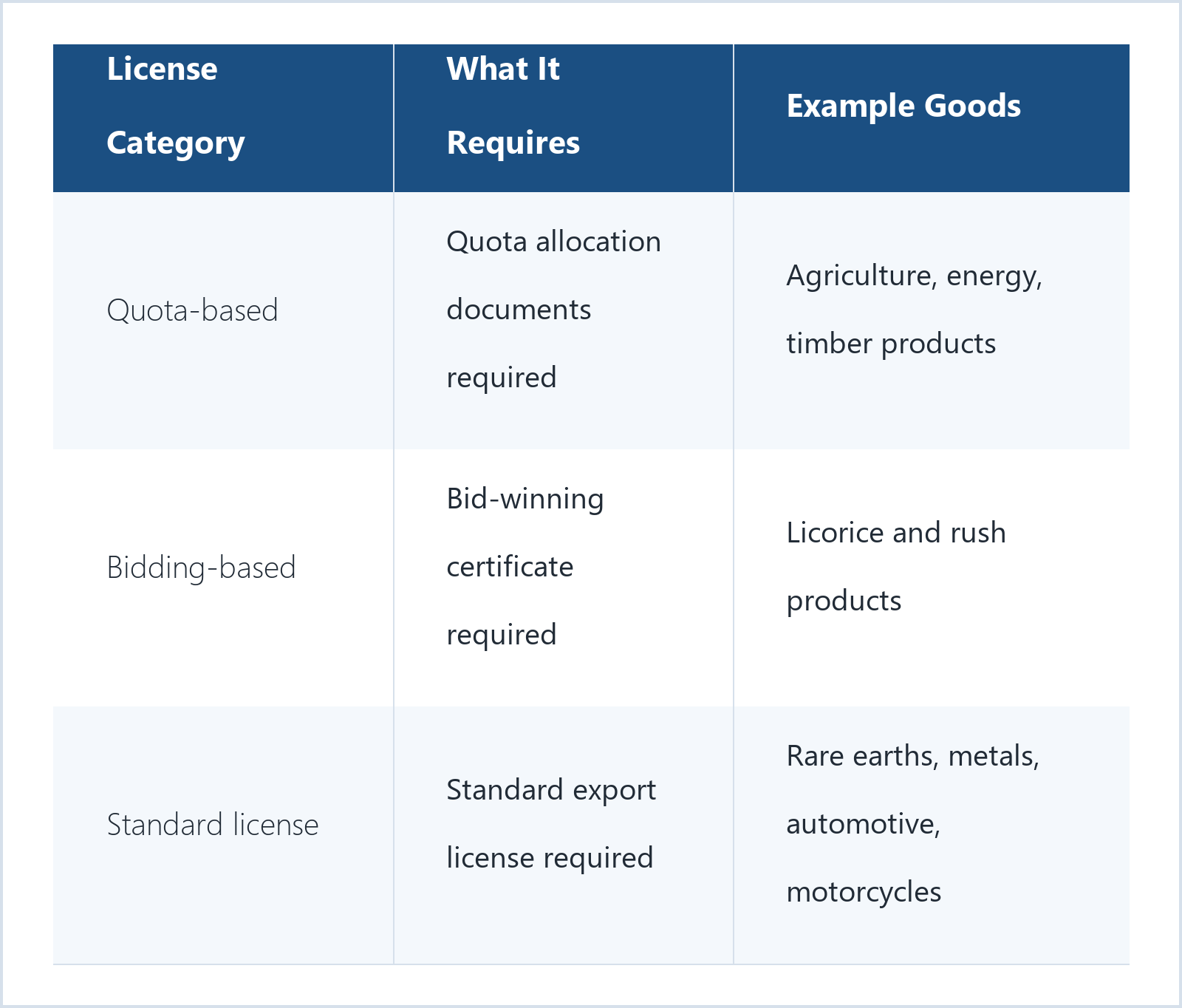
The Ministry of Commerce (MOFCOM) and GAC jointly published the Export License Management Goods Catalog (2026), effective January 1, 2026. A total of 43 goods categories now require export licenses. The table below summarizes the three main license types.
Special attention: Dual-use items now require a separate dual-use export license under China's Export Control Law. A standard export license alone is not enough.
Non-one-batch-one-certificate system: Applies to wheat, corn, rice, live animals, crude oil, refined oil, coal, motorcycles, and new automobiles. Allows up to 12 customs clearances within the license validity period.
One-batch-one-certificate system: Applies to ozone-depleting substances, used automobiles, and natural sand. Single-use only.
Suspended designated ports: The designated port requirements for magnesia, rare earths, and antimony products remain suspended.
The 2026 Dual-Use Items and Technology Import/Export License Management Catalog took effect on January 1, 2026. Exporters of goods on the dual-use list must obtain a separate dual-use export license under China's Export Control Law.
Importantly, goods that already hold a standard export license but also fall under dual-use control must additionally obtain the dual-use license before customs clearance. Goods with an approved dual-use license are exempt from standard export license requirements.
Beyond customs rules, the State Administration of Foreign Exchange (SAFE) introduced several trade facilitation measures in 2026:
Expanded pilot programs for high-level opening-up in cross-border trade and investment.
Enhanced cross-border financial services platform with new application scenarios.
National implementation of cross-border fund pooling management for multinational corporations.
Optimized foreign exchange services for cross-border e-commerce and market procurement trade.
Continued digitalization of export documentation for faster customs clearance.
Review product classifications. Check whether your goods fall under any of the 43 licensed categories or dual-use control items.
Update return logistics processes. Use the new cross-customs return flexibility to cut reverse logistics costs on 9610 e-commerce shipments.
Apply for licenses early. Export license processing times vary. Start applications 4 to 6 weeks before shipment.
Digitize documentation. Most ports accept electronic filings alongside paper. Digital submissions usually process faster.
Consult a customs broker. For complex goods or first-time exports, professional customs clearance support prevents costly compliance errors.
9610 is the customs code for cross-border e-commerce retail export goods. The April 2026 update lets returned 9610 goods re-enter China through any customs district, not just the original export port.
MOFCOM's 2026 catalog lists 43 categories. They include agricultural products, energy commodities, metals, rare earths, and vehicles. The exact category depends on the HS code and product description.
One-batch-one-certificate means the license is valid for a single customs clearance. Non-one-batch-one-certificate allows up to 12 clearances within the license validity period.
If a standard export license is required, the dual-use license is additional. If the goods only need a dual-use license, the standard export license is not required.
Start 4 to 6 weeks before the planned shipment. Processing times vary by product and licensing authority.
Linkyourfactory helps exporters handle customs clearance, export documentation, and Ocean Freight from China. If you are unsure whether your product needs a license or how to handle 9610 returns, our team can review your shipment before it moves.
Copyright @ Link your factory
SitemapBack to top
This website uses cookies to ensure you get the best experience on our website.



 E-mail
Comment
(0)