

Importing from China to the UK means dealing with the UK's own tariff schedule, not the EU's. You pay import duty based on the commodity code, then 20% VAT on the landed value (goods + freight + insurance + duty). As of mid-2026, the system runs through the Customs Declaration Service (CDS), and a few changes around data format and certain China-origin goods are worth knowing before you file.
The UK's legacy CHIEF platform is closed; all declarations now run on CDS. Before you file, have the 10-digit commodity code and the VAT base (goods + freight + insurance + duty) ready, or the declaration bounces and the container waits.
The UK uses the UK Integrated Online Tariff (the "UK Tariff") set by HMRC. The math for a China-origin shipment is:
Goods value — the CIF or ddp value per the commercial invoice.
Import duty — percentage set by the 10-digit commodity code.
VAT base — goods value + freight + insurance + duty.
Import VAT — 20% of that base (standard rate).
So duty and VAT stack on different bases. A £10,000 order with £800 freight and 4% duty looks roughly like: duty £400; VAT base £11,200; VAT £2,240. You reclaim the VAT if you are VAT-registered, but you still need the cash up front.
The UK uses 10-digit commodity codes (the first 6 digits are the international HS code, the rest are UK-specific). The code sets:
The duty rate (0%, 2%, 4%, 6.5%, 12% are common ranges)
Whether anti-dumping duty applies (steel, aluminium, bikes from China are examples)
Whether a license or certificate is required
Misclassifying to get a lower rate is a problem HMRC checks. Get the code right from the start; your forwarder or a classification tool can confirm it.
The core rates did not shift wholesale, but the practical filing did:
CDS is now the only channel. The old CHIEF system is fully retired. All declarations go through the Customs Declaration Service, which uses different data fields and requires an Economic Operator Registration and Identification (EORI) number.
More detailed origin data. Post-Brexit rules of origin and China-specific valuation checks mean HMRC asks for clearer proof of the transaction value, especially on related-party or low-value declarations.
Anti-dumping and trade remedy updates. Certain steel, ceramic, and aluminium products from China carry UK trade remedy duties that were reviewed in 2025–2026. If your product is in these categories, the rate can be far above the base tariff.
Low-value rules unchanged but enforced tighter. Consignments under £135 are handled differently (VAT collected at point of sale for B2C), but above that threshold the full duty and VAT process applies.
For classification details, see our guide on import duty and the Customs Clearance steps that apply at the UK border.
You need a GB EORI number to import. Without it, the border stops your goods. The CDS declaration requires:
EORI number
10-digit commodity code
CIF value and currency
Incoterm (FOB, CIF, DDP, etc.)
Country of origin (China)
Licenses or certificates if the code demands them
A common 2026 snag is suppliers issuing commercial invoices that do not show the right Incoterm or origin, forcing a corrected declaration and a delay.
Customs warehousing — defer duty/VAT until goods leave the warehouse.
Inward processing — if you import to process and re-export, duty can be suspended.
Tariff quotas — some goods have reduced rates under quota.
Documentary evidence for VAT reclaim — keep the C79 certificate from HMRC to recover import VAT if registered.
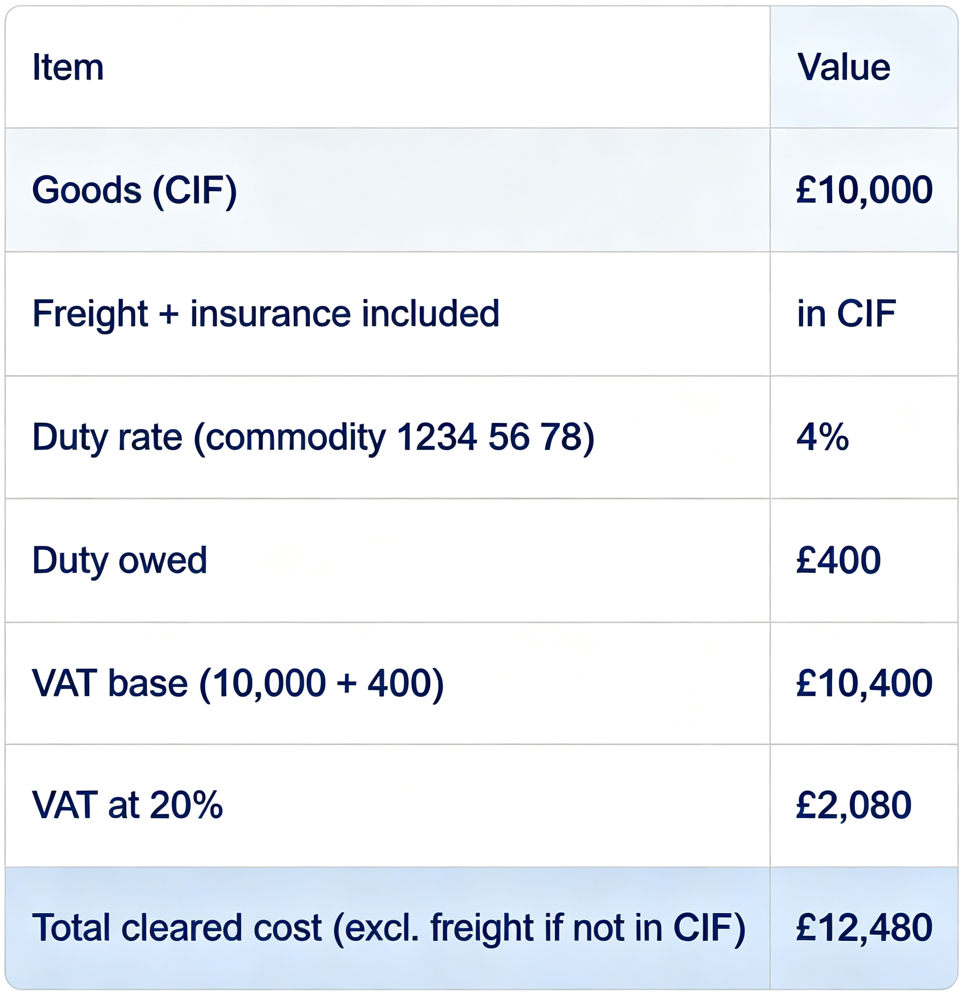
If freight was separate (FOB), add it to the VAT base too. The pattern holds: duty on goods, VAT on the wider landed base.
Confirm your GB EORI is active before ordering.
Lock the 10-digit commodity code with your forwarder.
Check trade-remedy duties for steel, aluminium, ceramics.
Make sure the commercial invoice shows Incoterm and China origin.
Budget VAT cash even if you reclaim it later.
File through CDS with complete data to avoid holds.
The UK model is straightforward once the code and the paperwork are right. The 2026 changes are mostly about cleaner data through CDS, not new tax rates.
What is the import duty from China to the UK in 2026?
It depends on the 10-digit commodity code; many goods fall between 0% and 12%, with some China-origin items (steel, aluminium, bikes) facing anti-dumping rates well above that. Check the UK Integrated Tariff for your code.
How much is UK import VAT on Chinese goods?
20% of the landed value (goods + freight + insurance + duty). VAT-registered businesses can reclaim it, but the payment is due at clearance.
Is CHIEF still available in 2026?
No. The CHIEF system is retired and all declarations go through the Customs Declaration Service (CDS), which requires a GB EORI number.
Do low-value parcels under £135 pay UK duty?
For B2C, VAT is collected at the point of sale and the £135 rule applies to VAT, but duty can still apply above the threshold. Business imports above £135 follow the full duty and VAT process.
How do I find the right commodity code?
Use the UK Integrated Online Tariff with your product description, or ask your freight forwarder. Correct classification affects duty, relief, and compliance, so confirm it before the first shipment.
Factories · Freight · Customs · Payment — all handled. Need help? Contact Linkyourfactory, your China supply-chain partner.
Copyright @ Link your factory
SitemapBack to top
This website uses cookies to ensure you get the best experience on our website.


Comment
(0)