

When you ship goods from China to France, the customs invoice is rarely the same as the supplier's invoice. You pay additional duties and value-added tax on top of the goods value, freight, and insurance, and the final landed cost depends on the product, the shipping method, and how the shipment is declared. This guide explains the charges in plain English and shows a real calculation you can copy for your own shipment.
The most common charges are customs duties, French import VAT, Customs Clearance fees, and destination handling. Some products also face excise duties, anti-dumping duties, or special import controls.
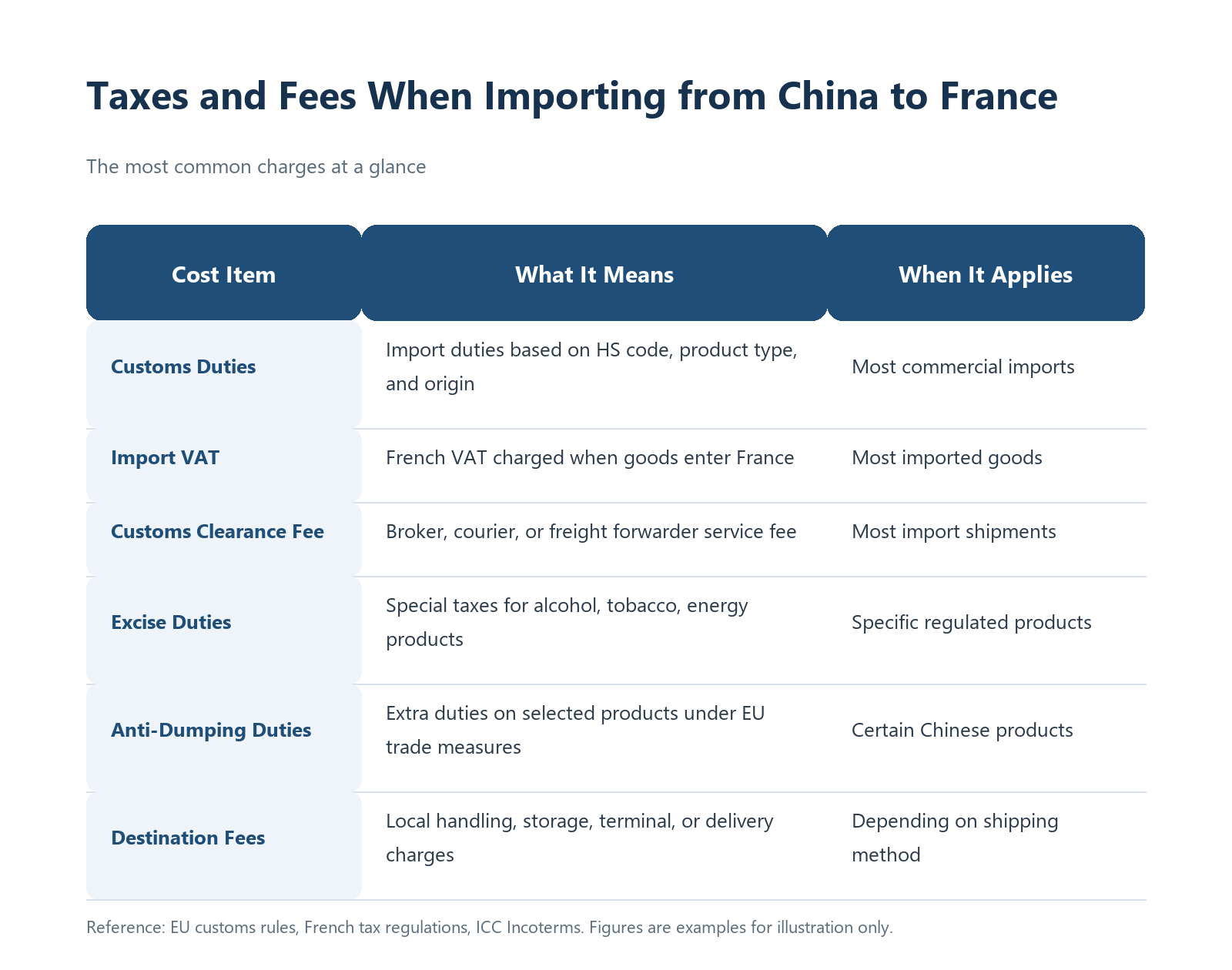
The simplest way to think about total landed cost is:
Landed Cost = Goods Value + Freight + Insurance + Customs Duties + Import VAT + Local Fees
The exact amount cannot be calculated by country alone. It depends on the HS code, customs value, VAT rate, and the way the shipment is declared.
French customs follows the European Union customs framework. The duty amount is driven by the HS code, the customs value, the country of origin, and any trade measures that apply to the product.
The main factors are:
HS code or TARIC classification
Customs value of the goods
Country of origin
Applicable duty rate
Trade defense measures such as anti-dumping duties
The HS code is the foundation of the duty calculation. It identifies the product category and sets the duty rate. For imports into France, you also need to check the EU TARIC system, which lists duty rates, import restrictions, trade defense measures, and product-specific requirements.
Classification depends on the product's material, function, technical specifications, and intended use. A small change in product characteristics can move the goods to a different HS code and a different duty rate. For example, electronic accessories, textile products, machinery parts, furniture, and auto components often have different classifications even when shipped under the same purchase order.
After you fix the HS code, French customs calculates duties on the customs value. For most China to France imports, the customs value is built with the CIF method, which adds the goods value, international freight, and insurance.
Even when goods are sold under FOB terms, freight and insurance are still added to the customs value. Here is how a typical CIF calculation looks:
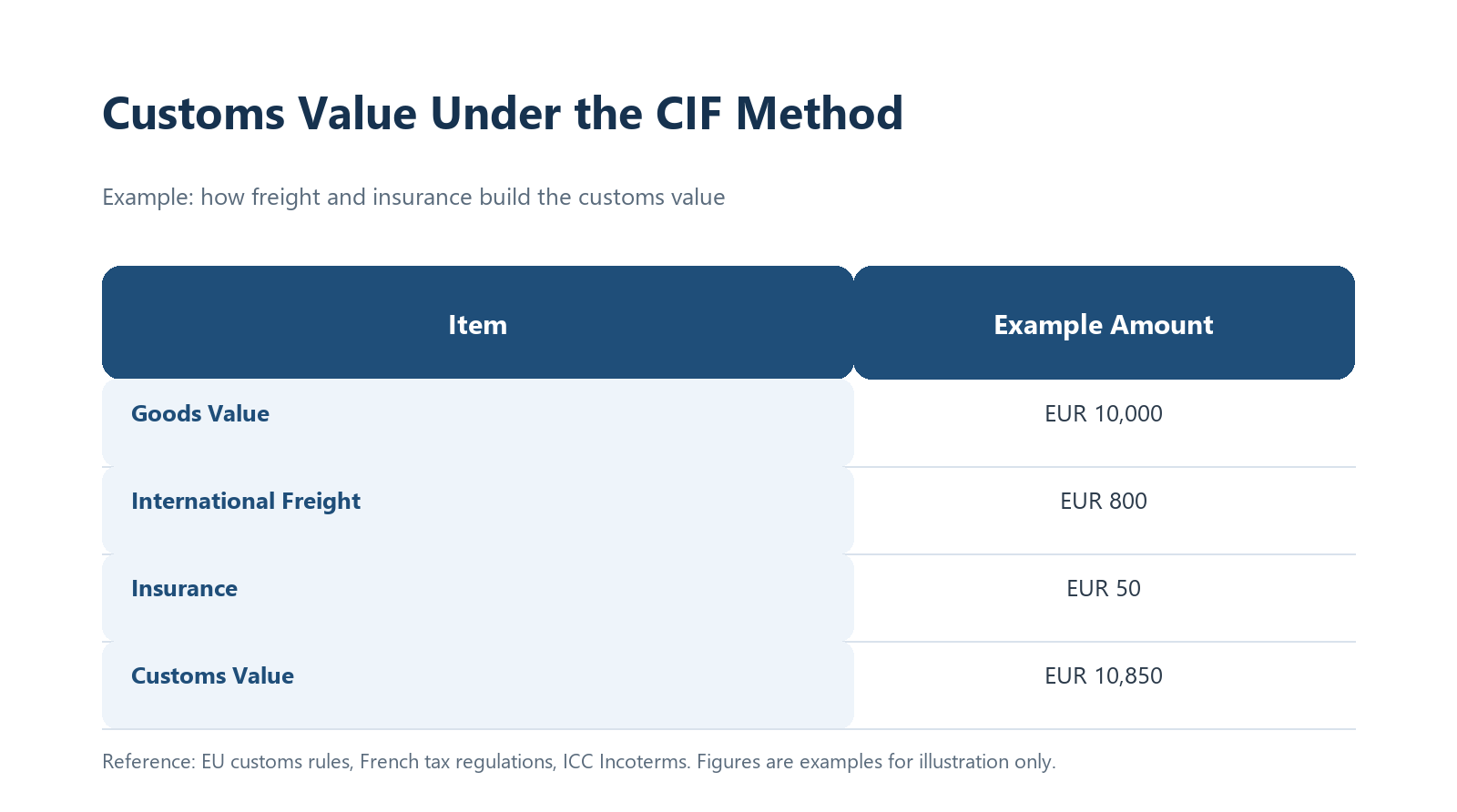
Customs duties are calculated on this total, not on the supplier's invoice alone.
There is no single duty rate for goods coming from China. The rate depends on the product category, HS code, country of origin, and EU tariff regulations. Some products face extra measures such as anti-dumping duties on items like steel, ceramics, footwear, and bicycles.
Confirm the applicable rate before placing a large order, especially for high-value goods or products that fall under EU trade defense measures.
Import VAT is one of the main costs for China to France imports. It applies to goods entering France from outside the European Union and is calculated separately from customs duties.
Unlike customs duties, which are tied to the HS code, import VAT is tied to the taxable import value. The VAT amount is affected by the customs value, the customs duties, and certain import-related charges.
Most commercial goods imported into France pay the standard 20% rate. Reduced rates apply to specific categories under French VAT rules:
20% standard rate: most commercial goods, including electronics, machinery, textiles, furniture, and industrial products.
10% reduced rate: certain categories defined under French VAT rules, such as some food, hospitality, and transport services.
5.5% reduced rate: essential goods and regulated categories, including most food products, books, and medical equipment.
2.1% super-reduced rate: limited categories, such as certain pharmaceutical products and press publications.
Confirm the correct VAT treatment before shipping, because the product category affects the final landed cost.
Import VAT is calculated on the VAT base, which usually includes the customs value, customs duties, and certain import-related charges.
Import VAT = VAT Rate x VAT Base
VAT Base = Customs Value + Customs Duties + Applicable Charges
Because freight and insurance are part of the customs value, the shipping method can shift the VAT amount. Higher air freight costs raise the taxable value compared with sea freight.
For VAT-registered businesses in France, import VAT can be reported through the VAT return instead of being paid in cash at customs clearance. This is called postponed import VAT accounting, and it helps importers keep cash on hand.
To use it, the importer needs:
Valid French VAT registration details
EORI number
Accurate customs declaration information
Correct product classification
Confirm your eligibility and reporting requirements with your tax advisor before importing.
For low-value B2C parcels shipped to French consumers from China, VAT treatment can differ from traditional commercial imports. Eligible sellers can use IOSS (Import One-Stop Shop) to collect VAT at the point of sale on goods valued at EUR 150 or less. This speeds up customs and prevents the buyer from getting an unexpected tax bill on delivery.
E-commerce sellers should confirm whether VAT is handled through a marketplace, their own IOSS registration, or courier collection at destination.
Goods valued at EUR 150 or less are a separate case, used by e-commerce sellers, dropshippers, and small parcel importers from China to French consumers.
Under current EU rules:
Goods under EUR 150 are generally exempt from customs duties.
Import VAT still applies from the first euro, unless IOSS or another scheme is used.
Couriers and postal operators may add their own handling or clearance fees.
The customs duty exemption does not mean the parcel is fully tax-free. Customs can still check the declaration if the value, product name, or HS code looks off. Small parcels may also trigger postal clearance fees, courier handling fees, product safety checks, or document requests.
For e-commerce sellers, those extra fees can hurt the customer experience. An unexpected tax or handling charge at the door often leads to complaints and returns.
French customs clearance depends on accurate commercial, transport, and regulatory documents. Missing or mismatched paperwork causes delays, storage fees, and inspections.
The two core documents are the commercial invoice and the packing list.
The commercial invoice drives the customs value and the duty and VAT calculation. It should include seller and buyer details, a clear product description, HS code, quantity, value, country of origin, and the agreed Incoterm. The description should match the actual goods, not a generic one-liner.
The packing list covers the number of packages, dimensions, gross and net weight, total volume, and product quantity. It should agree with the commercial invoice and the actual cargo.
The transport document depends on the shipping method:
Bill of Lading (B/L): required for sea freight. Confirms cargo receipt and transportation terms.
Air Waybill (AWB): required for air freight. Identifies the carrier, shipper, consignee, and cargo information.
Rail transport documents: required for rail freight, depending on the route and carrier.
For commercial imports into France, the importer usually needs:
EORI number: identifies the importer in the EU customs system. Required for any formal customs procedure.
VAT identification number: required for business imports and import VAT reporting.
Some goods must meet European Union standards before entering France. Depending on the product, you may need:
CE Declaration of Conformity
Test reports
Safety certificates
Certificate of Origin
Technical documents
Electronics, machinery, toys, medical devices, and other regulated products almost always need extra compliance paperwork.
To calculate the total, work through three steps: build the customs value, apply the duty rate, then apply the VAT rate on the VAT base.
Step 1: Customs Value
Customs Value = Goods Value + Freight + Insurance
Step 2: Customs Duties
Customs Duties = Customs Value x Customs Duty Rate
Step 3: Import VAT
Import VAT = VAT Rate x VAT Base
VAT Base = Customs Value + Customs Duties + Applicable Charges
A French importer buys electronic products from a Shenzhen supplier and ships them by air freight. The numbers come out as follows:
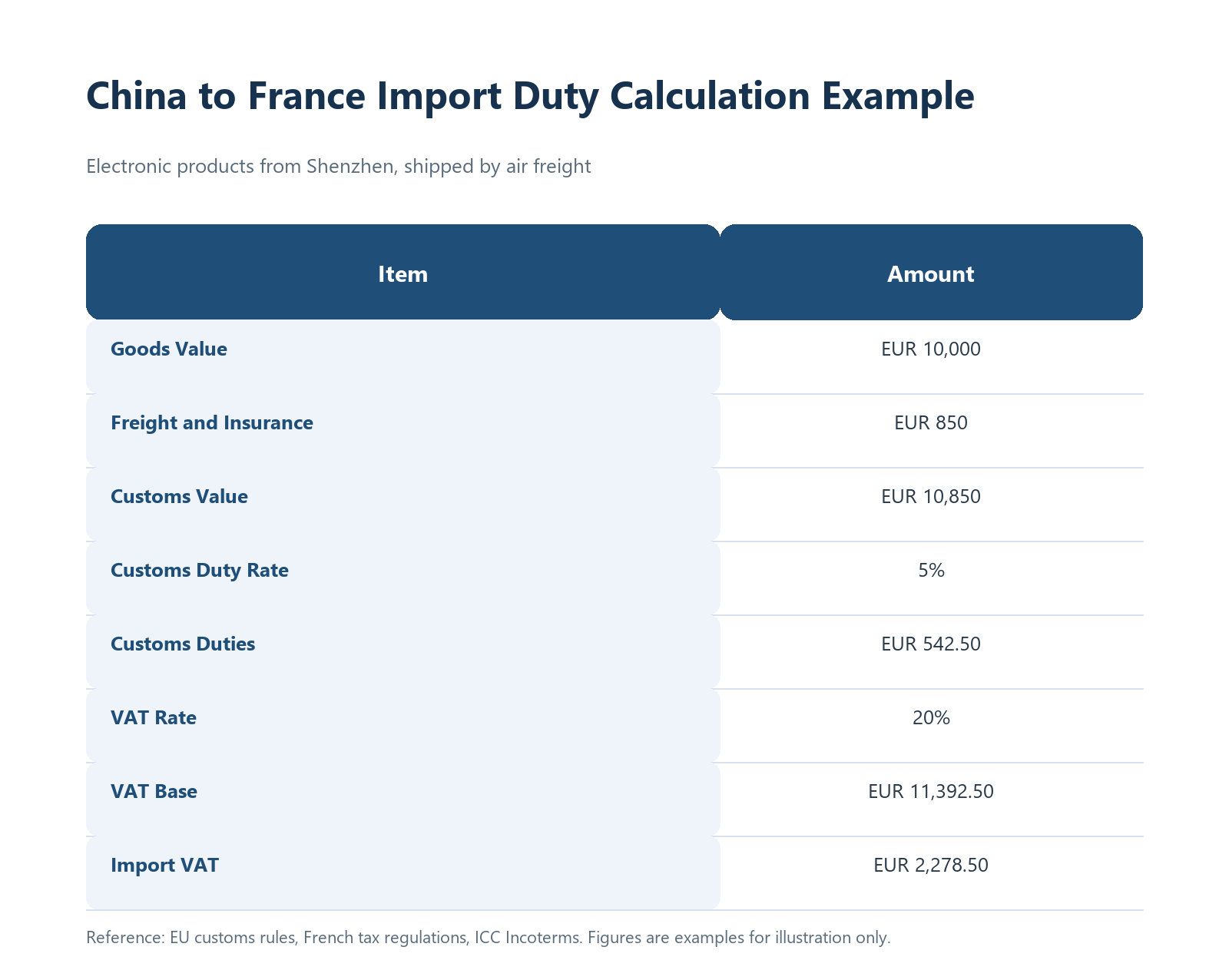
In this example, the importer pays EUR 542.50 in customs duties and EUR 2,278.50 in import VAT. Total duties and taxes are EUR 2,821.00, before any customs clearance service fees, storage, local handling, or final delivery charges.
Freight, insurance, duty rate, and VAT all move the final landed cost, so run the numbers before confirming the order.
The shipping method affects both transit time and the customs value. Different products call for different options.
Express is the fastest choice for small shipments, samples, spare parts, documents, and urgent e-commerce orders. Major couriers offer door-to-door delivery with customs clearance support. The cost per kilogram is higher than other modes, and the courier may add handling fees at destination.
Air freight works for shipments that need faster delivery but are too large or heavy for express. Common air cargo from China to France includes electronics, fashion products, replacement parts, high-value goods, and seasonal inventory. Transit time is usually around 5 to 10 days, depending on the departure airport, airline schedule, customs clearance, and final delivery address.
Rail freight sits between sea and air. It is faster than sea, cheaper than air, and well suited to machinery parts, automotive components, industrial products, and medium-volume commercial shipments. Transit time depends on the rail route, border procedures, and last-mile delivery.
Sea freight is the cheapest option for large volumes and heavy cargo. Common goods include furniture, machinery, household goods, construction materials, textiles, and retail inventory. You can choose FCL (Full Container Load) for large shipments, or LCL (Less Than Container Load) for smaller cargo that shares container space. Sea freight takes longer, but the lower Shipping Rates make it the default for many businesses importing from China to France, especially via Ocean Freight.
DDP (Delivered Duty Paid) means duties and taxes are included in the door-to-door service. The seller or its agent handles customs procedures on the buyer's behalf, which is useful for importers who do not want to deal with customs directly.
DDP often fits:
Small commercial shipments
E-commerce inventory
Amazon or warehouse delivery
Buyers with no import experience
Multi-supplier consolidation
Use DDP with care. Confirm who acts as the importer of record, whether the seller can provide proper tax documents, and whether the goods are suitable for a DDP service. For formal B2B imports, most French companies prefer to import under their own EORI number and VAT account, which gives clearer control over customs records, import VAT, and compliance.
There is no single rate. The duty depends on the product HS code, country of origin, and any EU trade measures that apply. Common rates for consumer goods fall in the 0% to 14% range, but some products carry higher rates or anti-dumping duties.
Yes. Since July 2021, the EU removed the small-parcel VAT exemption. Import VAT applies to almost all commercial imports from China to France, including low-value parcels. The standard rate is 20%, with reduced rates for some product categories.
Yes, for customs duties. Goods valued at EUR 150 or less are generally exempt from customs duties, but import VAT still applies from the first euro. Couriers and postal operators can still charge handling and clearance fees.
For commercial imports above the EUR 150 threshold, yes. The EORI number identifies you in the EU customs system and is required for any formal customs declaration. Without it, the goods can be held at the border.
Customs duty is a tax on the imported product, calculated on the customs value at the HS code rate. Import VAT is a consumption tax applied on top of the customs value plus duties, at the French VAT rate. Both are paid at the border, but only VAT can be recovered by VAT-registered businesses through the French VAT return.
Importing from China to France is not a single flat fee. The customs invoice you pay depends on the HS code, the customs value, the duty rate, the VAT rate, and the shipping method. The simplest way to control the total landed cost is to fix the HS code early, build the customs value with the CIF method, and pick a shipping mode that matches the product and the timeline.
Need a real number for your shipment? Send us the product, the quantity, the shipping method, and the destination city, and we will work out the duty, VAT, and freight together.
Copyright @ Link your factory
SitemapBack to top
This website uses cookies to ensure you get the best experience on our website.



 E-mail
Comment
(0)