

Most customs holds are not random. They come from wrong declared values, missing licenses, or paperwork that does not match across documents. Fix the documents and you avoid the single biggest cause of delayed shipments. Below are the nine mistakes that get cargo stuck, and the fix for each.
Buyers sometimes ask suppliers to lower the invoice value to cut duty. Customs systems flag values that sit far below the normal range for that HS code. The shipment is held, the importer pays a penalty, and the goods still clear at the real value.
Fix: declare the true transaction value. If your price is genuinely low (samples, defective units), write that on the invoice with a reason.
The HS code decides your duty rate and whether the product needs a license. A code that is too broad, or simply wrong, triggers a classification review.
Fix: confirm the HS code with your broker before booking. Use the full 10-digit subheading for your destination market, not just the 6-digit international base.
An invoice with no buyer and seller addresses, no Incoterm, or no country of origin is incomplete. Customs cannot match it to the shipment.
Fix: require a complete invoice from the supplier. It must show parties, Incoterm (FOB, CIF, etc.), origin, and a clear description matching the packing list.
If the invoice says 1,000 units in 10 cartons but the packing list says 12 cartons, customs questions the whole file. Mismatches are a top reason for inspection.
Fix: reconcile both documents before departure. The carton count, weights, and dimensions must agree across invoice, packing list, and bill of lading.
Many markets give lower duty under trade agreements (RCEP, EU GSP, USMCA rules) only with a valid certificate of origin. Without it, the shipment is held or pays the full rate.
Fix: ask the supplier for a certified certificate of origin early. Confirm the format your customs authority accepts, since each program differs.
Certain goods need a license before they enter: FCC for electronics in the US, CE documentation for the EU, SABER for Saudi Arabia, SFDA for food and medical items. Arriving without them means a hold or rejection.
Fix: check the license list for your product and market before production. Build the certificate into the timeline so it is ready at loading. See our compliance guides for market-by-market rules.
A typo in the consignee name, a wrong port, or a BL that says "to order" when your bank needs a straight BL will stop clearance.
Fix: review the BL draft against the invoice before the supplier releases it. Small errors on a BL are expensive to correct after sailing.
If the invoice calls it "plastic toy" and the packing list says "children's gift," the system sees two different products. Descriptions must be consistent and specific.
Fix: agree on one exact product name with the supplier and use it on every document. Avoid vague words like "parts" or "samples" for commercial cargo.
Some importers file the entry after the container arrives. In busy ports that gap means storage fees and a hold until the file is complete.
Fix: file the declaration as soon as you have the BL and commercial documents, ideally before arrival. Your broker can submit pre-clearance in most systems.
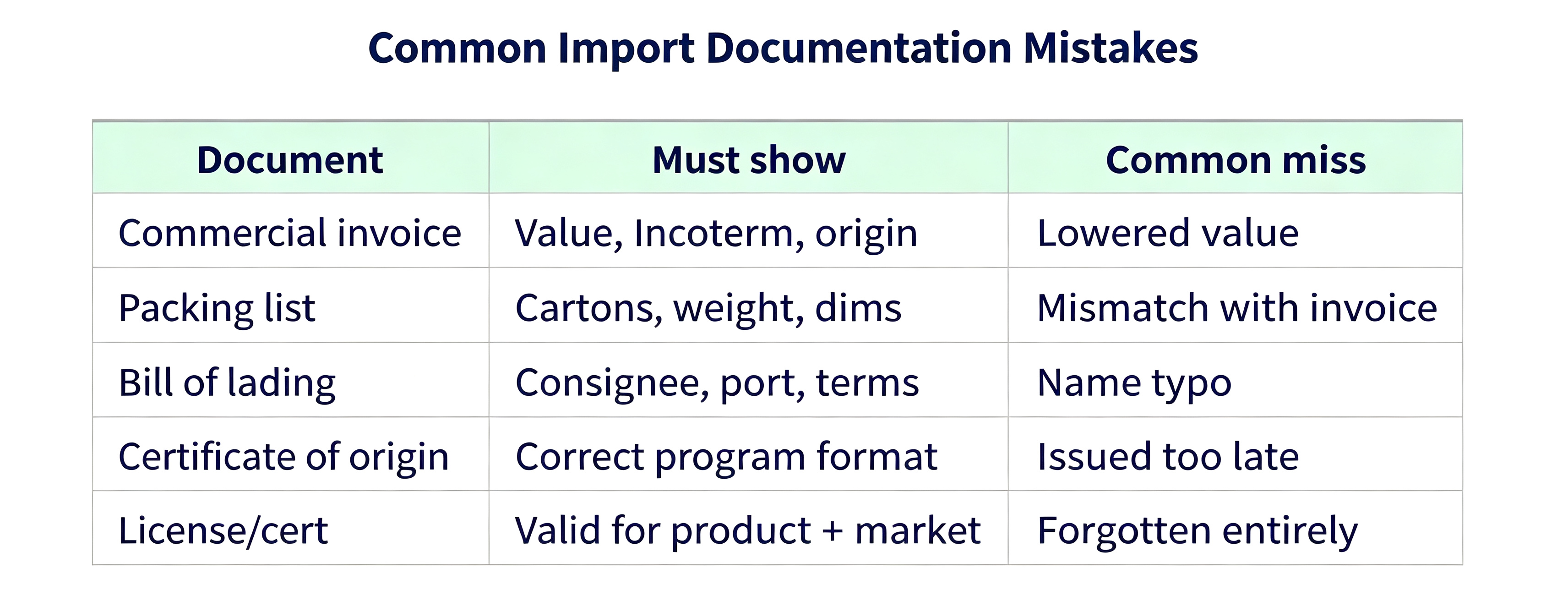
Run this table against your file before the supplier hands documents to the forwarder. Most holds disappear when the set is clean.
Keep digital copies of every document in one folder, named by BL number, and share it with your broker the moment the container is booked. Brokers who receive a complete set early can pre-check classification and flag a missing license days before arrival, when there is still time to fix it without storage fees. The holds that cost the most are the ones found at the gate, not the ones caught in a pre-check.
For a deeper look at clearance mechanics, our customs clearance and documentation articles cover each form in detail.
Why is my shipment held at customs?
Usually wrong value, a wrong or missing HS code, or documents that do not match. Licenses missing for regulated goods is the other common cause.
How long can a customs hold last?
A document fix often clears in a day or two. A license or valuation dispute can take weeks. Faster resolution comes from submitting the correct paper the first time.
Does under-declaring value actually save money?
Rarely. The duty saved is small versus the penalty, delay, and seized-goods risk if caught. Declare the true value.
Can my freight forwarder fix documents after arrival?
Sometimes, but corrections after sailing cost more and slow clearance. Fix the file before the container departs China.
Which document matters most to avoid a hold?
The commercial invoice, because value and origin flow from it to every other form. Get it right and the rest is easier to reconcile.
Copyright @ Link your factory
SitemapBack to top
This website uses cookies to ensure you get the best experience on our website.



 E-mail
Comment
(0)